To MyGrid
MyGrid
ModuleTwo 4.22 kWh: 1 base module + 1 expansion module
ModuleTwo 4.22 kWh: 1 base module + 1 expansion module.

Choose your capacity

Store it now. Use it later.

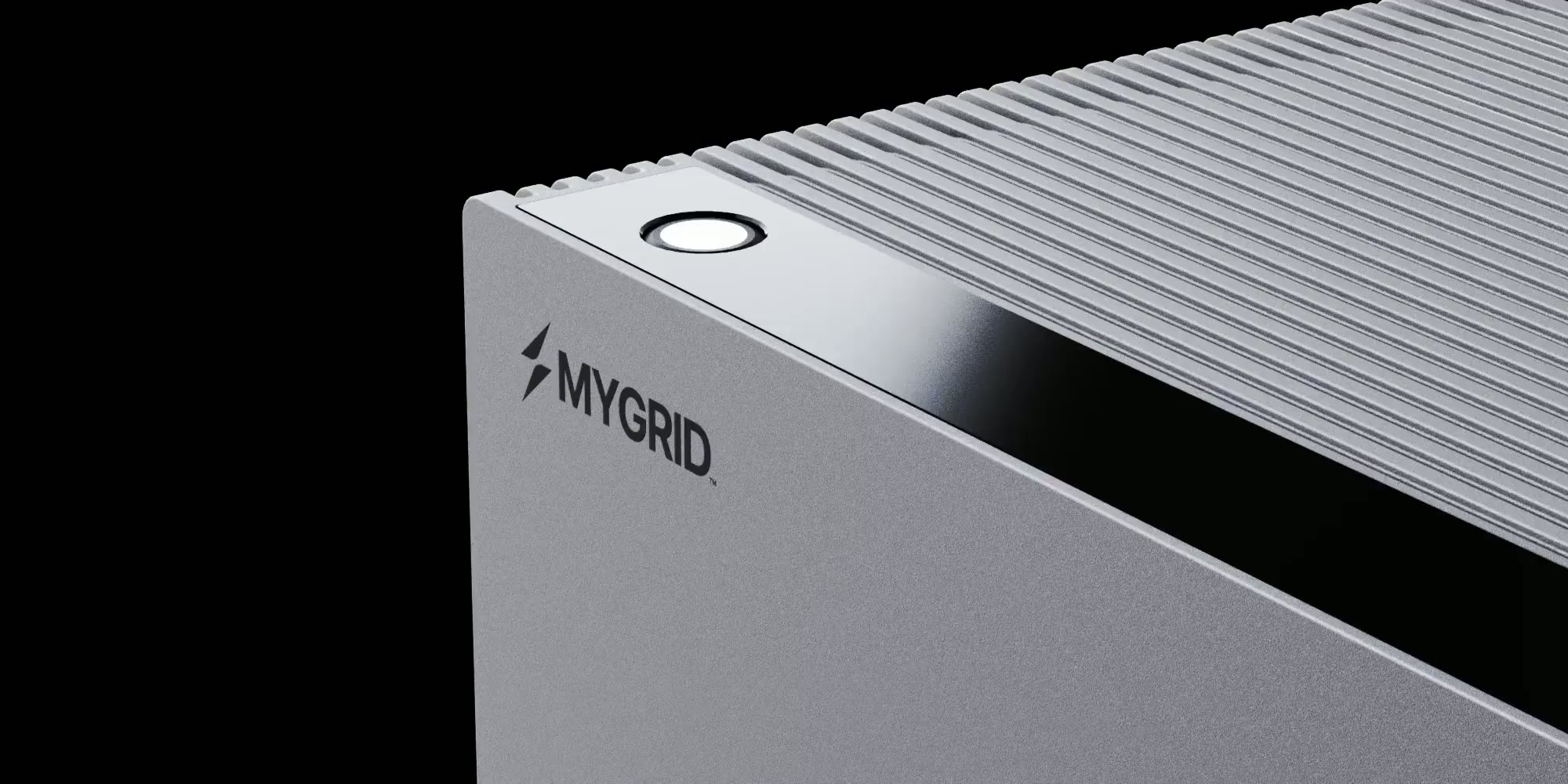
ModuleTwo.
Your plug-in home battery.

Save your solar energy for the evening, or charge when electricity is cheap. Plug ModuleTwo into an earthed socket and it handles charging and discharging automatically. See exactly what’s happening in the MyGrid Energy app.

  • Expandable from 2.11 to 10.55 kWh
  • App and P1 VoltBridge included
  • Support from our Brussels team

€1,499€355 per kWh

Included: MyGrid Energy app with smart control, P1 VoltBridge (meter reader), VAT and shipping.

MyGrid DataLock™: your data stays yours, stored in Europe →

YOUR SELECTION IN EVERYDAY LIFE

What can you do with 4.22 kWh?

Enough for an average household's normal evening use (± 2.5 kWh), with some to spare.

Everyday devices

  • ± 250timesCharge a smartphone± 15 Wh per full charge
  • ± 65timesCharge a laptop± 60 Wh per full charge
  • ± 180hoursRun a fridge± 21 W on average (≈ 7 days)
  • ± 380hoursKeep the Wi-Fi router on± 10 W
  • ± 40hoursWatch TV± 100 W

Bigger consumers

  • ± 4timesRun the dishwashereco programme, ± 0.9 kWh
  • ± 5.5hoursRun a split air conditionersmall unit, ± 700 W
  • ± 4.5hoursSupport a heat pump800 W of its consumption

How it works

Three steps. Zero installer.

  1. Plug into an earthed socket

    A standard 230 V socket is all you need. No new wiring and no changes to your existing solar panels.

  2. Connect the P1 VoltBridge

    Click VoltBridge into the P1 port of your smart or digital meter. It sends your import and export readings directly to ModuleTwo over your home network.

  3. Smart control does the rest

    Connect the battery and VoltBridge in the MyGrid Energy app. ModuleTwo charges from solar surplus or during cheaper hours and supplies power when you need it, matched to your energy contract.

App and control

Control your home battery with the MyGrid Energy app

The included P1 VoltBridge reads your smart meter in real time through the P1 port, so the app always knows how much electricity you use and feed back to the grid. Those measurements build a picture of your consumption patterns: when you shower, cook or charge your car. Our AI model compares this with hourly electricity prices and the weather forecast. If tomorrow is expected to be sunny, the battery needs less charging overnight. The model then decides each hour whether charging or discharging offers the greatest benefit. The longer ModuleTwo runs, the more accurate that prediction becomes.

Prefer to control it yourself? Take over through the app, Home Assistant or other integrations.

  • Download on the App Store
  • Get it on Google Play

Smart storage, your way

Who is a plug-in home battery for?

Solar panels, a dynamic energy tariff or both: choose what fits your household.

  • With solar panels

    Use more of your own solar energy.

    ModuleTwo stores your solar surplus for later. Use the electricity you generate during the day in the evening too.

    Solar power and household use on an example dayLine chart of an example day: solar output peaks around midday at 1,500 W while household use stays around 300 to 450 W and peaks in the evening at 850 W. The green area between 9am and 5pm is the surplus that goes to the battery.04008001.2001.60006121821surplus → batteryfrom the battery in the eveningpower (W)solar panelshousehold use
    Example day. Between roughly 9am and 5pm your panels produce more than your home uses. That surplus goes into ModuleTwo and comes back in the evening.
  • With a dynamic energy tariff

    Charge when electricity costs less.

    Have a dynamic tariff? ModuleTwo charges during the cheapest hours of the day. If you have solar panels, your own generation takes priority. You can combine both too — set your profile when connecting.

    Electricity price per hour on an example dayBar chart of an example day: the electricity price is about €0.15 per kWh at night and peaks around 6pm at €0.38. The night hours are marked as charging, the evening peak as supplying.0.00.10.20.30.40006121823price (€/kWh)charge (cheap)supply (expensive)
    Example day on a dynamic tariff. Power is cheapest at night and most expensive around 6pm. ModuleTwo charges during the cheap hours and supplies during the peak.

Solar panels + dynamic tariff

Solar and prices, together.

Hybrid strategy

The ultimate hybrid strategy. The AI-driven algorithm continuously weighs up current weather forecasts, electricity prices and your historical consumption to calculate the most profitable decision every quarter-hour.

  • Plenty of sun expected

    Room for your own solar energy. The system proactively discharges or keeps capacity available.

  • Little sun expected

    Top up when electricity costs less. The AI anticipates the shortfall and charges in time.

How does self-consumption work?

How can you get more from your solar panels?

ModuleTwo stores your solar surplus for later, so electricity generated during the day is also there when your panels produce little or nothing. The battery works alongside your existing inverter.

Daytime / EveningDiagram: during the day 400 W of solar power goes to the home and 300 W to ModuleTwo; in the evening ModuleTwo supplies that power to the home. DaytimeEveningSolar panels700 WHome400 W in useModuleTwo+300 W charging300 W spareSolar panels0 WHomeevening usageModuleTwostored solar powerDaytime / EveningDiagram: during the day 400 W of solar power goes to the home and 300 W to ModuleTwo; in the evening ModuleTwo supplies that power to the home. DaytimeEveningSolar panels700 WHome400 W in useModuleTwo+300 W charging300 W spareSolar panels0 WHomeevening usageModuleTwostored solar power
Example: your panels produce 700 W and your home uses 400 W. The 300 W left over would normally go to the grid. ModuleTwo stores it and gives it back to your home in the evening.
What changes when net metering ends?

Net metering in the Netherlands ends in 2027. Storing your own solar energy for later therefore becomes more important.

From 1 January 2027, exported electricity is no longer offset against the electricity you take from the grid. You still receive compensation for what you export. Using stored solar energy later reduces what you need to buy; the actual financial benefit depends on your tariff, your usage and charging losses.

Source: Dutch government on the net metering scheme ↗

Driving electric? Your battery doesn't need to keep up with your charger

An EV charger draws far more power than a plug-in battery can deliver, and that's fine. ModuleTwo supplies up to 800 W to your everyday household use, such as your fridge, Wi-Fi and lighting.

That way a smaller battery covers part of your usage for hours, also when the car isn't charging. You charge the car as usual, with solar power or power from the grid.

The right capacity depends on your usage, your solar output and your energy tariff.

Three-phase connection? You don't automatically need a three-phase battery

ModuleTwo delivers power on one phase. Does your smart meter net the three phases against each other at the same moment? Then what the battery delivers on one phase counts towards your total consumption. So your measured consumption can go down, even though the battery is connected to just one phase.

How that works

A meter like this looks at the balance of all three phases at every moment. An example: phase 1 has no other load and the battery delivers 800 W there. On phases 2 and 3 you draw 800 W in total. The meter then sees a net result of roughly zero. Whether your meter works this way depends on the meter type and your grid operator. Not sure? Ask them.

Smart meterThree-phase diagram: ModuleTwo supplies 800 W on phase 1, the home uses 500 W on phase 2 and 300 W on phase 3, the smart meter sees a net of about 0 W. Phase 1ModuleTwo supplies 800 W+800 WPhase 2Usage 500 W−500 WPhase 3Usage 300 W−300 WSmart meterbalance right now+800 − 500 − 300net ≈ 0 W
Example with a meter that nets the phases at the same moment: +800 W on phase 1 and −800 W across phases 2 and 3 gives a net result of about zero.
  • This is about metering and netting. The battery doesn't physically supply every phase.
  • During a power cut, the backup outlet only powers the devices you plug into it: not your whole home and no three-phase appliances.
  • The limits of your wiring, your circuit and the battery (800 W through a regular socket) still apply.
  • This is not the same as net metering. Net metering is a yearly settlement by your supplier; this is about what your meter measures at the same moment.
Read how the P1 VoltBridge reads your meter
MyGrid ModuleTwo plug-in home battery on film

More than storing energy

More possibilities with your ModuleTwo home battery.

Flexible to place, backup for your appliances and room for your own solar energy.

A home battery that moves with you.

You connect ModuleTwo to a suitable earthed socket. No fixed installation is needed: handy for a rented home, an apartment or a house where you would rather not change anything. If you move, you take the battery with you. Start with 2.11 kWh and expand later to 10.55 kWh.

Extra modules add storage. Power through a normal socket stays 800 W.

ModuleTwo in a garage, with no fixed installation
ModuleTwo in a garage: on the floor, in an ordinary earthed socket. No drilling, no work in the meter cupboard.

Virtual neighbourhood battery

Together, we reduce your neighbourhood’s peaks.

In Amsterdam-Sporenburg and Hilversum, we are developing neighbourhood projects where home batteries work together. Residents can help reduce demand peaks and ease pressure on the local grid.

MyGrid DataLock™ logoMyGrid DataLock™

Your energy. Your data. Your control.

ModuleTwo is hardware-locked at the factory and linked to MyGrid’s secure environment. It only starts with software approved by MyGrid. We manage the firmware, security keys and cloud ourselves. Your energy data stays in the European Union. And the MyGrid Energy app keeps you in control.

  • Locked on the chip

  • Secure communication

  • Our own EU cloud

Co-funded by the European Union

Plug-in or fixed home battery: what’s the difference?

Compare ModuleTwo, the plug-in home battery, with a permanently installed home battery.

  • Installation

    MyGrid ModuleTwo
    Connect it yourself to a suitable earthed socket.
    Fixed home battery
    An electrician runs cabling to the fuse box, usually a dedicated circuit, and connects the battery or hybrid inverter.
  • Purchase price

    MyGrid ModuleTwo
    €1,499 for 4.22 kWh, incl. VAT and shipping.
    Fixed home battery
    Guide prices: 5 kWh €3,550 excluding installation; 10 kWh about €5,675 including installation. Both including 21% VAT.
  • Start using it

    MyGrid ModuleTwo
    Plug it in as soon as your set is delivered.
    Fixed home battery
    An electrician comes to install it; expect around 2–3 hours of work.
  • Moving house

    MyGrid ModuleTwo
    Disconnect and take it with you, following the instructions.
    Fixed home battery
    An electrician needed again for dismantling and connection at the new place.
  • Expanding later

    MyGrid ModuleTwo
    From 2.11 to 10.55 kWh, in 2.11 kWh steps.
    Fixed home battery
    Expandable with compatible modules, for example in 5 kWh steps. Additional installation work may be needed.
  • Power to your home

    MyGrid ModuleTwo
    Up to 800 W via a normal socket; up to 1,200 W on a suitable dedicated circuit (configured in the app).
    Fixed home battery
    Indicative examples: 1.7 kW per unit up to about 4–10 kW for larger systems, depending on model and connection.
AspectMyGrid ModuleTwoFixed home battery
InstallationConnect it yourself to a suitable earthed socket.An electrician runs cabling to the fuse box, usually a dedicated circuit, and connects the battery or hybrid inverter.
Purchase price€1,499 for 4.22 kWh, incl. VAT and shipping.Guide prices: 5 kWh €3,550 excluding installation; 10 kWh about €5,675 including installation. Both including 21% VAT.
Start using itPlug it in as soon as your set is delivered.An electrician comes to install it; expect around 2–3 hours of work.
Moving houseDisconnect and take it with you, following the instructions.An electrician needed again for dismantling and connection at the new place.
Expanding laterFrom 2.11 to 10.55 kWh, in 2.11 kWh steps.Expandable with compatible modules, for example in 5 kWh steps. Additional installation work may be needed.
Power to your homeUp to 800 W via a normal socket; up to 1,200 W on a suitable dedicated circuit (configured in the app).Indicative examples: 1.7 kW per unit up to about 4–10 kW for larger systems, depending on model and connection.

Customer experiences

4.5/54.5 out of 5 stars

I first bought one ModuleTwo. It works fine, so I expanded straight away to 8.44 kWh. At least my solar energy no longer goes back to the grid.

Annicq B.

5/55 out of 5 stars

At first it took some searching to find the Home Assistant integration, but with V2 of the app it now works excellently. I have fully automated the battery based on my heat pump's consumption.

Pieter W.

4/54 out of 5 stars

Because I already use a lot of my own electricity, I mainly use the battery off-grid in my workshop. I also connected four solar panels to it. Really practical, also for charging my electric bikes.

W.

Specifications

ModuleTwo specifications

Dimensions of the ModuleTwo Master base unit
Dimensions of the ModuleTwo Master base unit.
Capacity
2.11 kWh per module; expandable to 10.55 kWh (5 modules)
Cell chemistry
Cobalt-free LiFePO4 (LFP)
Charging power
Up to 1,200 W from the socket
Discharging power
Up to 800 W through a regular socket; up to 1,200 W on a suitable dedicated circuit. Expansion modules add storage, not power.
Round-trip efficiency
Up to 91% measured in tests charging and discharging combined, depending on power level and conditions. At low charge or discharge power, and at low temperatures, efficiency is lower. Our calculations use 89%.
Solar inputs
4 inputs to connect solar panels directly (optional). Panels with their own inverter keep working through your home's wiring.
Maximum solar input
2,600 W in total across all 4 inputs, not per input. This is separate from the 1,200 W charging power from the socket.
Backup power
Separate 230 V outlet up to 1,200 W for the devices you plug into it; not for the whole home
Connection
Earthed socket (230 V) plus your smart meter's P1 port, via the included P1 VoltBridge
Ingress protection
IP65 — dust-tight and protected against water jets.
Warranty
10 years or 6,000 cycles, whichever comes first, under the warranty terms
Security and data
MyGrid DataLock™: every time it starts, ModuleTwo checks that its software is approved by MyGrid. Data is exchanged securely and aggregated meter data is stored in our own EU cloud.
Integrations
MyGrid Energy app, Home Assistant, MQTT, EnergieID
Included
MyGrid Energy app with smart control, P1 VoltBridge (meter reader), VAT and shipping

Frequently asked questions about plug-in home batteries

What is a plug-in home battery?

A plug-in home battery connects to an earthed socket, so it doesn't have to be wired into your fuse box or inverter. ModuleTwo is one of these: you choose from 2.11 to 10.55 kWh of storage, and the smart control system handles charging and discharging automatically through the MyGrid Energy app.

How much power is 2.11 kWh, and what can you do with it?

For one 2.11 kWh base module, we estimate about 1.9 kWh for your appliances at 89% efficiency. That is around 130 smartphone charges, 90 hours for a fridge or 190 hours for a Wi-Fi router. A small split air conditioner can run for about 2.5 hours. With 10.55 kWh, those figures are five times higher. ModuleTwo supplies up to 800 W at once, so it covers part of the demand from larger appliances. These are separate examples; actual consumption and efficiency depend on the appliance and conditions.

How much does a MyGrid plug-in home battery cost?

ModuleTwo costs €999 for 2.11 kWh. A 4.22 kWh set costs €1,499 6.33 kWh costs €2,049 8.44 kWh costs €2,599 and 10.55 kWh costs €3,199 All prices include VAT, shipping, the P1 VoltBridge and the MyGrid Energy app. Already have a ModuleTwo? A separate expansion module costs €899

How is it different from a fixed home battery?

A fixed home battery is wired into your fuse box or inverter by an installer, and it usually delivers more power. A plug-in battery like ModuleTwo goes into an earthed socket, and you can set it up yourself. Its output is lower (up to 800 W through a regular socket), but there's no building work, the upfront cost is smaller and you can take it with you when you move.

Does ModuleTwo work with my existing solar panels?

Yes. ModuleTwo works alongside your existing inverter, and nothing changes on your solar panels. The battery is plugged into a socket and reads your smart meter through the P1 VoltBridge. That's how ModuleTwo knows when you have power left over.

An example: your panels produce 700 W and your home is using 400 W. ModuleTwo sees that roughly 300 W is going to the grid, and charges at about that rate, within the limits of the battery and your settings.

Can I connect solar panels directly to ModuleTwo?

You can, but you don't have to. ModuleTwo has 4 solar inputs with a combined maximum of 2,600 W. That's the total, not per input. Panels that already have their own inverter can stay as they are: their power reaches the battery through your home's wiring. The connection ratings are in the ModuleTwo user manual (PDF).

Do I need an installer?

Not for the standard setup. You plug ModuleTwo into an earthed socket that meets the guidelines in the manual, and click the P1 VoltBridge into your smart meter yourself. Unsure about your socket or circuit, or want to deliver up to 1,200 W on a dedicated circuit? Then have an electrician take a look.

What do I need to connect ModuleTwo?

  • An earthed socket in a suitable spot, such as indoors, in a garage or in a storage room. It must meet the guidelines in the manual.
  • A smart meter with a free P1 port. The included P1 VoltBridge reads how much power your home draws and feeds back. It only passes on meter data; the power for your devices doesn't run through the VoltBridge.
  • Wi-Fi, for the MyGrid Energy app and the control system.

No smart meter, or no free P1 port? We support other meter readers too, such as Shelly devices. Email the meter type to hello@mygrid.energy. All connection requirements are in the ModuleTwo user manual (PDF).

I don't have a smart meter, or there's no free P1 port. Can ModuleTwo still work?

Get in touch with us in that case. The P1 VoltBridge is the standard solution, but it isn't the only one. We also support other meter readers and dongles, such as Shelly devices, so ModuleTwo can still tell how much power your home draws and feeds back.

What's possible depends on your meter and your meter cupboard. Email the make and model of your meter to hello@mygrid.energy, ideally with a photo of the cupboard. We'll tell you which solution fits your situation, before you order.

Does ModuleTwo work without solar panels?

Yes, if you have a dynamic energy contract or a day/night tariff. ModuleTwo then charges during the cheap hours and supplies that power to your home when prices are higher. Whether it pays off depends on three things: the price gap between those hours, the round-trip efficiency (89% used in calculations; up to 91% measured in tests, depending on power level and conditions) and how much usage you can shift. On a fixed tariff without solar panels, there's little to gain.

The Netherlands: what changes when net metering ends?

Until 31 December 2026 you can offset the solar power you feed back against the power you use (the salderingsregeling). From 1 January 2027 that scheme ends in one go. For power you feed back, you'll only get a feed-in payment from your supplier, and some suppliers charge feed-in fees (Dutch government). Every kWh you store and use later is a kWh you don't have to buy.

I live in Belgium. What does a home battery do there?

In Flanders the reverse-running meter has already been abolished. With a digital meter you now get only a few cents per kWh for the power you feed back, while you pay the full rate for power from the grid. So every kWh you store and use later is a kWh you don't have to buy.

There is also the capacity tariff. Since 2023, part of your grid costs is based on your monthly peak: the highest quarter-hour power you draw from the grid that month. Your bill follows the average of your twelve monthly peaks, with a floor of 2.5 kW. The rate varies by grid operator and year.

What ModuleTwo does about it: it supplies up to 800 W through a regular socket and so covers part of your peak. If your average monthly peak sits above 2.5 kW, that's worth about €40 a year. If you're already at or below the floor, flattening gains you nothing extra, because you pay the minimum either way. It also can't fully cover sustained heavy loads such as a heat pump or an EV charger.

The Netherlands: can I reclaim the VAT on a home battery?

In some cases, yes. The Dutch Tax Administration explains when you can reclaim the VAT on a home battery and which obligations come with it. Check the current rules on belastingdienst.nl or ask your adviser. All prices on this page include VAT.

How much power does ModuleTwo deliver, and what does the backup outlet do?

Through a regular socket, ModuleTwo supplies up to 800 W to your home. On a suitable dedicated circuit, that's up to 1,200 W. Charging from the socket runs at up to 1,200 W. So the battery won't fully cover large peaks from, say, a heat pump, induction hob or EV charger; the calculator takes that limit into account.

Power cut? The separate 230 V backup outlet supplies up to 1,200 W to devices you plug straight into it, such as your fridge, router or a lamp. It doesn't power your whole home or three-phase appliances.

I have a three-phase connection. Do I need a three-phase battery?

Not automatically. ModuleTwo delivers power on one phase. Does your smart meter net consumption and feed-in across the three phases at the same moment? Then what the battery delivers on its phase counts towards your total consumption. Whether your meter works this way depends on the meter type and your grid operator. It's about metering and netting: the battery doesn't physically supply every phase and isn't backup power for your whole home.

Can I expand later?

Yes. You start with a 2.11 kWh base module and add 2.11 kWh expansion modules later, up to 10.55 kWh in total. A separate expansion module costs €899 Expanding adds storage, not power: the charging and discharging power stays that of the base module.

How much can I save with a home battery?

That depends on your usage, your energy contract and whether you have solar panels. ModuleTwo achieved up to 91% round-trip efficiency in tests, depending on power level and conditions. The calculator on this page deliberately stays on the cautious side, assuming 89% efficiency, 330 full charge cycles a year and a maximum output of 800 W. The result is an estimate based on your own figures, not a promise.

What about the warranty and lifespan?

ModuleTwo uses cobalt-free LiFePO4 (LFP) cells, chosen for their long life and thermal stability. You get a warranty of 10 years or 6,000 charge cycles, whichever comes first, under the warranty terms.

When will my order be delivered?

You'll see the current delivery time for your set on the product page in the shop, before you check out. Select the Netherlands as your delivery country there. Shipping is included in the price.

Does ModuleTwo work with Home Assistant?

Yes. You can connect both the P1 VoltBridge and ModuleTwo to Home Assistant, and ModuleTwo also supports MQTT. That way you follow your energy data in your own dashboard and add ModuleTwo to your own automations. Readings travel over your home network straight to ModuleTwo; aggregated data goes to our own EU cloud, for the MyGrid Energy app.

Ready for your ModuleTwo?

Choose your set and order in the MyGrid shop.

ModuleTwo 4.22 kWh

€1,499

incl. VAT and shipping

We also deliver to other EU countries. Select ‘EU’ as your destination in the shop.

Questions? Email us